Beyond Off-the-Shelf: Why Custom Applications for Businesses Are Your New Competitive Edge
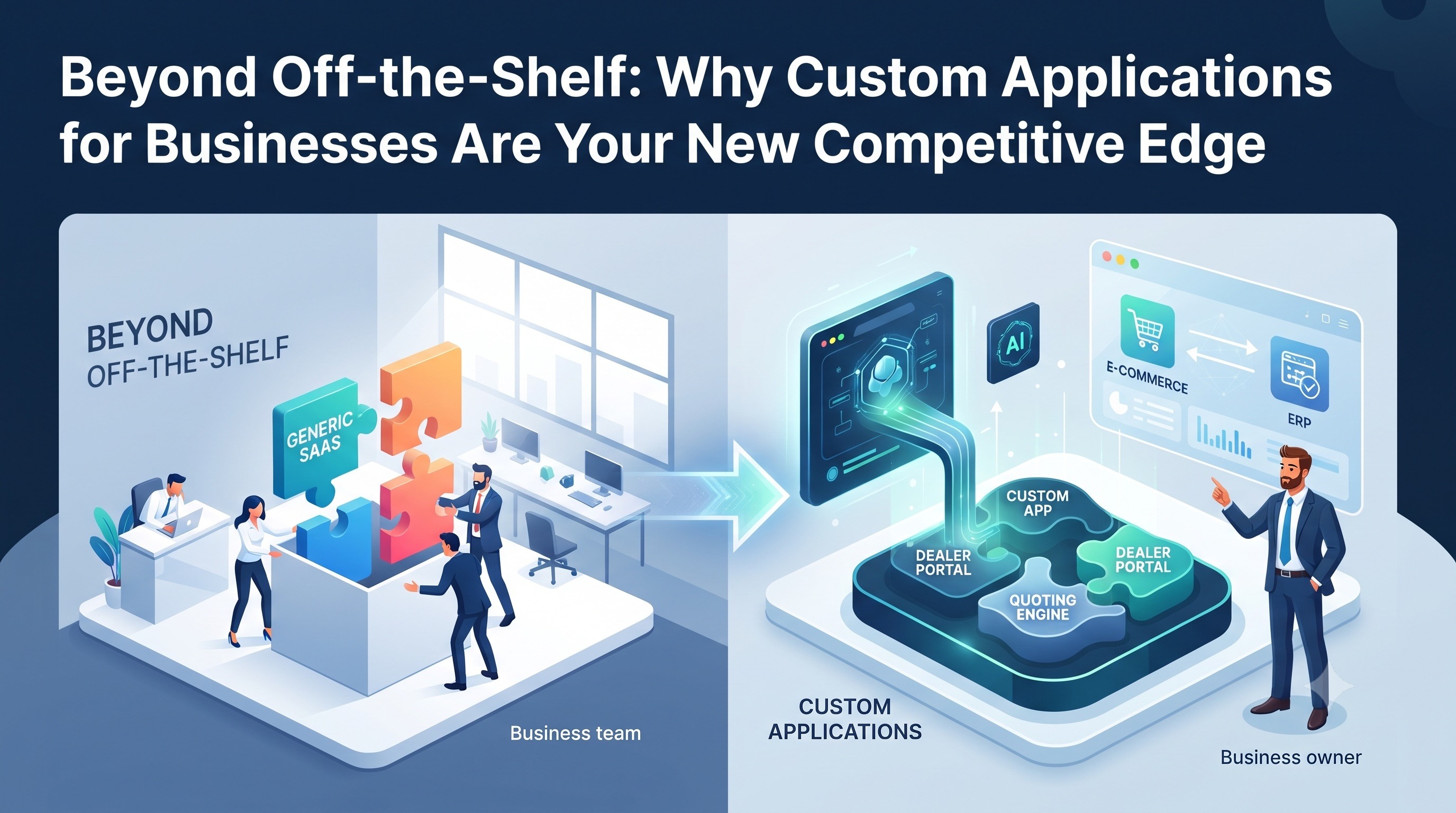
For years, the gold standard for small and medium-sized businesses (SMBs) was simple: find a SaaS subscription, sign up, and force your team to fit their workflows into the software’s rigid structure. If the software didn't quite handle your unique pricing, or if it couldn't talk to your ERP, you simply "made do."
But the landscape of applications for businesses has shifted. The era of compromising your operations to suit a software’s limitations is over. We are entering the age of the adaptive enterprise, where custom applications are no longer reserved for industry giants, but are becoming the most powerful weapon in the SMB toolkit.
The AI Revolution: Democratizing Custom Software
Historically, building custom applications for businesses—like a bespoke dealer portal, an automated quoting system, or a custom supply-chain bridge—was a high-stakes, high-cost endeavor. It required months of development and deep technical resources.
Today, AI has obliterated those barriers.
By leveraging AI-assisted development, we can now translate complex business logic into functional, high-performance applications at a fraction of the traditional cost and time. This means SMBs can finally build software that bends to their business model, rather than the other way around.
Why Your Business Needs "Adaptive" Applications
If you are currently relying on a patchwork of generic SaaS subscriptions, you are likely suffering from "process friction"—where your team spends more time managing software than managing the business. Here is why bespoke applications are changing the game for leaders:
- Workflow Harmony: A custom application acts as a digital reflection of your specific business rules. Whether it’s complex BOM (Bill of Materials) calculations for manufacturing or unique tiered-pricing for a dealer network, your software should handle the heavy lifting, not your team.
- Data Integrity Across Platforms: The biggest inefficiency in SMBs is the "silo effect." A custom application serves as the bridge, ensuring your e-commerce front-end and your backend ERP (like WinMan) communicate in real-time. No more manual data entry; no more reconciliation errors.
- User-Centric Design: Why train employees on a platform with 100 features they’ll never use? Custom applications provide a simplified, role-specific interface that puts only the necessary tools in front of the right person, drastically increasing operational speed.
Moving From "Software Users" to "Software Architects"
The shift we are seeing is profound: business owners are moving from being passive software users to becoming architects of their own digital ecosystems.
When you stop trying to force your business into a "one-size-fits-all" box, you unlock a level of efficiency that your competitors—who are still bogged down by generic SaaS limitations—simply cannot match. You aren't just buying a tool; you are codifying your competitive advantage into a scalable software asset.
The Bottom Line
In 2026, the question is no longer "Can we afford to build a custom application?" The question is "Can we afford to continue losing efficiency by relying on software that wasn't built for us?"
True digital transformation isn't about digitizing old processes; it's about leveraging technology to enable new, faster, and more profitable ways of working.
Are you ready to stop adapting your business to your software? Building custom applications for businesses doesn't have to be a multi-year project. If you’re looking to streamline your dealer portal, automate your quoting processes, or bridge your e-commerce data with your ERP, let's start a conversation about what an adaptive system looks like for your specific industry.